Quick answer
Puma Punku is part of Tiwanaku (Tiahuanaco), a UNESCO World Heritage site about 70 km (1.5-2 hours by road) west of La Paz, Bolivia, at roughly 3,850 m. A Bs 100 ticket for foreigners (about US$8, cash only) covers the main ruins, both museums and Puma Punku. The site opens daily 09:00-16:00. Take a guided day tour or a minibus from La Paz's cemetery district, and allow 3-4 hours on site.
On this page
- Where is Puma Punku?
- Tiwanaku tickets, hours and costs (2026)
- How to get to Tiwanaku from La Paz: tour or DIY
- What to see at Tiwanaku, in walking order
- The Gate of the Sun: what the carving shows
- Puma Punku: the H-blocks, the drill holes and who built it
- What happened to Tiwanaku? A short history
- Altitude, weather and what to bring
- Is Tiwanaku worth visiting?
- Frequently asked questions
Puma Punku is one part of Tiwanaku (Tiahuanaco), capital of a civilization that, according to UNESCO, dominated a large area of the southern Andes and peaked in AD 500-900, centuries before the Incas. The ruins sit on the treeless Altiplano 70 km west of La Paz, Bolivia, at about 3,850 m (12,630 ft). Looting and quarrying left mostly platforms and scattered stone, but the Gate of the Sun, 175 carved heads, a 7 m monolith and Puma Punku’s H-shaped blocks justify the trip. We checked prices and hours on the official site in September 2026.
- Altitude
- about 3,850 m (12,630 ft)
- From La Paz
- 70 km, 1.5-2 h
- Ticket
- Bs 100 (about US$8)
- Hours
- 09:00-16:00 daily
- Payment
- Cash only
- Time needed
- 3-4 h
Where is Puma Punku?
Puma Punku is inside the Tiwanaku archaeological site in Ingavi Province, Bolivia, about 15 km from Lake Titicaca. It lies 1 km southwest of the Kalasasaya and the museums. The site is off Route 1, the highway from El Alto to the Peruvian border at Desaguadero, 40-50 km farther west by road.
Search results often place Puma Punku in Peru or “the Bolivian jungle”. It stands on open, treeless Bolivian grassland at 3,850 m. Tiwanaku’s influence did reach Peru’s Moquegua Valley and northern Chile, which may explain part of the mix-up.
Tiwanaku tickets, hours and costs (2026)
| Visitor | Ticket | In US$ (Sept 2026) |
|---|---|---|
| Foreign visitors | Bs 100 | about $8 |
| Bolivian nationals | Bs 15 | about $1.25 |
| Bolivian school students | Bs 5 | about 40 cents |
One ticket covers the main complex, both museums and Puma Punku; keep it until you’re done. The fees come from the official Tiwanaku website, run by CIAAAT, the state body that manages the site, and could change now that the boliviano floats (since 26 June 2026).
- Hours: 09:00 to 16:00 daily, per the official site (some guides and Google say 17:00). Arrive by late morning.
- Payment: cash only, in bolivianos. Withdraw in La Paz, since rural ATMs can run empty (Bolivia currency guide).
- Guides: local guides at the entrance charge about Bs 150-200 (US$12-17) per group, per La Paz Life (September 2026), our only source with a figure. Agree on price, language and whether Puma Punku is included.
A do-it-yourself day costs about Bs 120-156 (US$10-13) for entry, the cable car and minibuses both ways, before lunch or a guide.
How to get to Tiwanaku from La Paz: tour or DIY
Allow 1.5 to 2 hours each way. The road climbs out of La Paz, crosses El Alto and heads west on Route 1.
| Option | Cost (Sept 2026) | Includes | Best for |
|---|---|---|---|
| Minibus from the cemetery | Bs 7-25 each way, plus entry | Transport | Tight budgets, some Spanish |
| Shared tour | $35 (no entry or lunch) to $65 (both) | Transport, guide | First-timers |
| Private tour | $150-170; $200 with Lake Titicaca | Own vehicle and guide | Time at Puma Punku |
Tiwanaku tours from La Paz
Inti Travel’s all-inclusive shared tour is typical: downtown pickup at 08:00-09:00, museums from 10:40, lunch at 14:15 and drop-off at the San Francisco church around 16:00, in groups of up to 12. Check whether entry and lunch are included (Buhos Tours’ $35 tour excludes both) and how long you get at Puma Punku. These two shared tours allow 20 and 30 minutes, short if the H-blocks are why you’re going.
Ratings are middling. In September 2026, Viator’s 25 Tiwanaku tours had 284 reviews between them, and the most-reviewed shared tour (Inti Travel’s, 81 reviews) averaged 3.9 stars. The only one at 4.5 or higher with over 50 reviews is Solace Trekking’s private Tiwanaku and Titicaca day, whose guided walk at the ruins lasts about 45 minutes.
| Tour | From | Best for | Check availability |
|---|---|---|---|
| Tiwanaku & Puma Punku - The Ancient Civilization - Everything Included!Free cancellation | $65 | Most reviewed, all-inclusive | Check price |
| Tour in Tiwanaku Archaeological RuinsFree cancellation | $35 | Budget shared (entry and lunch extra) | Check price |
| Tiwanaku & Puma Punku - Private Service.Free cancellation | $170 | Private, Tiwanaku only | Check price |
| Private Tiwanaku and Titicaca Day Trip from La PazFree cancellation | $200 | Private + Lake Titicaca | Check price |
| Private Tour from Puno to Tiwanaku and PumapunkuFree cancellation | $239 | Private from Puno, Peru | Check price |
Prices in US$ per person from Viator as of Sep 30, 2026. They change; you see the final price before paying.
Public minibus from the cemetery
- Ride the Red Line of the Mi Teleférico cable car from Estación Central to Cementerio (Bs 3, about 25 cents).
- Minibuses (shared vans) leave beside the General Cemetery. Bolivia Turismo names calle José María Asín; La Paz Life says across from the main gate, past the flower sellers. Others leave from El Alto’s interprovincial bus terminal.
- They go when full (Bolivia Turismo says every 30 minutes). Ask the driver for “las ruinas”.
- Pay in cash. Quoted fares run from Bs 7 (official FAQ, undated) to Bs 15-25 each way (La Paz Life, September 2026), and diesel rose 83% on 18 September 2026, so confirm the fare when you board.
- Minibuses back thin out in the late afternoon. We’d be at the roadside by 16:00, when the site closes.
From Puno or Cusco (Peru)
Travelers crossing from Puno at Desaguadero pass Tiwanaku 40-50 km into Bolivia. To stop, book a tour or arrange transport; Viator sells a private day trip from Puno from about $239. US citizens haven’t needed a tourist visa since 1 December 2025 (Bolivia visa rules), and our Cusco to La Paz guide covers the border.
Current conditions (as of September 2026)
- Blockades cut off La Paz from 1 May to 23 June 2026 and emptied Tiwanaku.
- A state of exception runs to about mid-December 2026.
- The US Embassy warned on 9 September of new fuel protests and blockades.
- The day before, check the road authority’s road-conditions map (Spanish), message your operator (all five tours above offer free cancellation) and read whether La Paz is safe right now.
What to see at Tiwanaku, in walking order
UNESCO protects 71.5 ha, a fraction of an ancient city that estimates put at 400 to 600 ha, and much of that area has never been excavated. Our suggested order follows the sections below, starting with the museums as Inti Travel’s tour does and ending at Puma Punku, 1 km southwest (about 15 minutes on foot).
The Ceramic and Lithic museums
The Ceramic Museum runs from the Formative-period Wankarani and Chiripa cultures to classic Tiwanaku pottery of AD 400-800, including keros, ceremonial drinking cups. The Lithic Museum holds the Bennett Monolith, more than 7 m tall, and a basalt chachapuma (puma-man).
Akapana pyramid
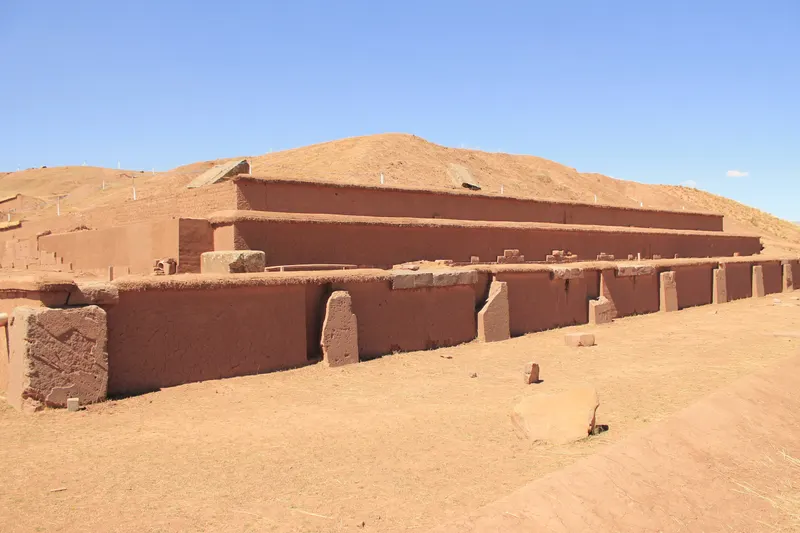
The Akapana is a man-made mound of about 257 by 197 m, once faced with sandstone and andesite in seven platforms more than 18 m high, with a temple on top (UNESCO). The summit holds traces of a sunken court shaped like a chakana, the stepped Andean cross, and the deep trench from its center to the east side is a looters’ excavation. Archaeologists found sacrificial offerings of humans and camelids here. A 2009 government restoration in adobe was halted after UNESCO complained.
Semi-subterranean Temple and its 175 heads
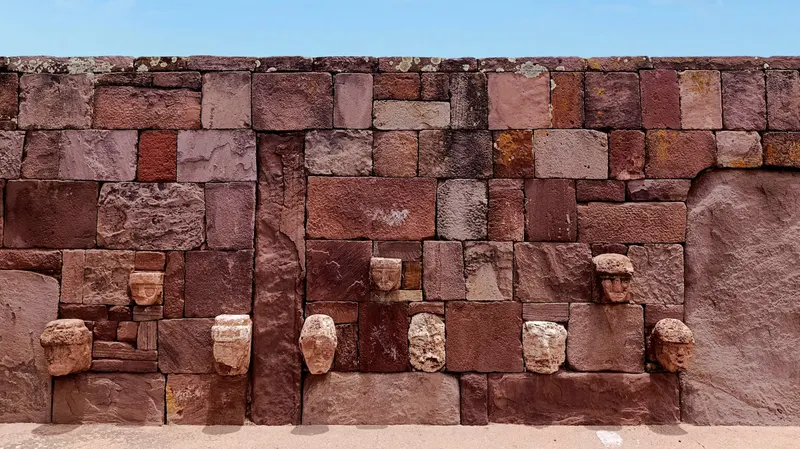
CIAAAT calls the Templete Semisubterráneo the oldest temple on the site and the only one entered from the south. Its court sits more than 2 m below ground, walled with 48 red-sandstone pillars (UNESCO) and set with 175 carved stone heads. These are the “Puma Punku faces” you see online, though they sit 1 km from Puma Punku. UNESCO links them to an older practice of displaying defeated enemies’ severed heads, and their mixed styles suggest the temple was reused over time.
Kalasasaya temple
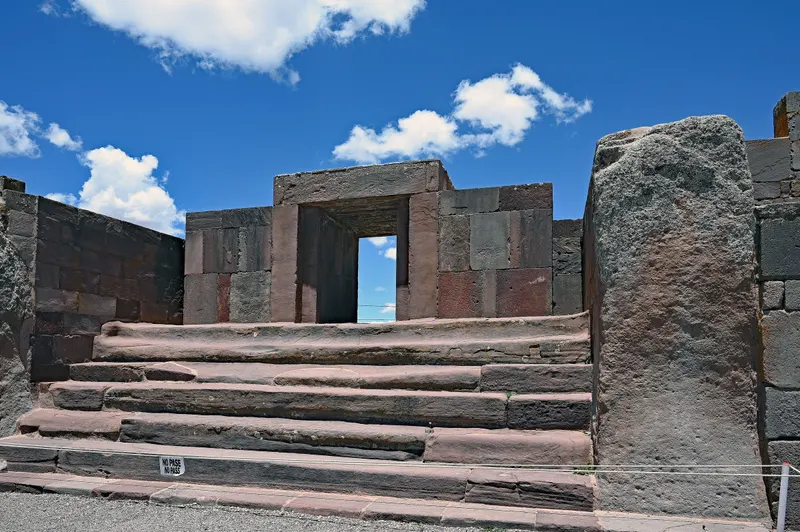
Kalasasaya means “standing stones” in Aymara. UNESCO says this rectangular platform temple, roughly 120 by 130 m (measurements vary), is believed to have been an observatory. Seven steps in the middle of the east wall lead in to the Ponce and Fraile monoliths and the Gate of the Sun. Most walls were rebuilt after excavations in 1957-1960, and the Wikipedia article on Tiwanaku notes the reconstruction was not well based on evidence.
Putuni, Kantatallita and Kherikala
According to CIAAAT, the Putuni is a late temple with its leaders’ residence on the west side and one of the main water channels, and the Kherikala held priests’ rooms. The Kantatallita’s 3 m lintel shows six warriors carrying axes and severed heads, with tiny holes where nails once held sheets of precious metal such as gold.
Tiwanaku’s monoliths: Bennett, Ponce, Fraile and Kon-Tiki
There’s no official count of Tiwanaku’s monoliths. These are the four you’ll see.
| Monolith | Where | Size and stone | Found | Look for |
|---|---|---|---|---|
| Bennett | Lithic Museum | 7.2-7.3 m, sandstone, about 18.5-20 t | 1932, by Wendell C. Bennett’s team | Spent 1933-2002 in La Paz |
| Ponce | Kalasasaya | Andesite | 1957 | A kero, a snuff tray, a Spanish cross on the shoulder |
| Fraile | Kalasasaya | Sandstone | No date in our sources | Belt of sprouting plants often read as crabs |
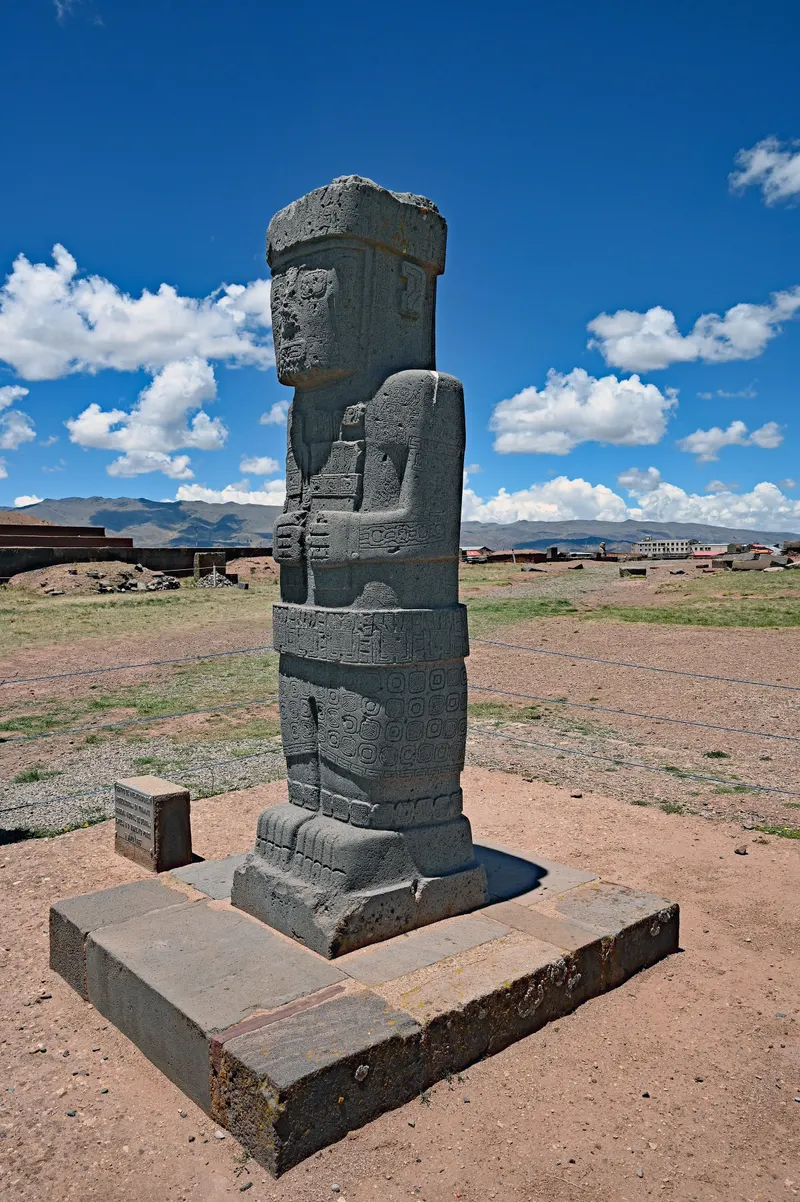
| Kon-Tiki (Bearded) | Semi-subterranean Temple | About 3 m, sandstone | 1932 | Stands at the center of the sunken court |
From about 1940 the Bennett Monolith stood beside La Paz’s Hernando Siles stadium, on what became Plaza del Monolito, until it returned in 2002 (some sources say 2000). The Ponce Monolith is on the back of the Bs 200 note.
The Gate of the Sun: what the carving shows
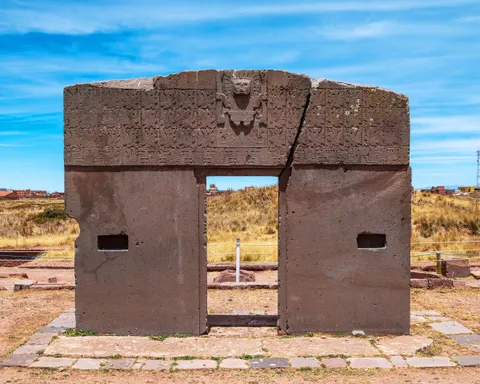
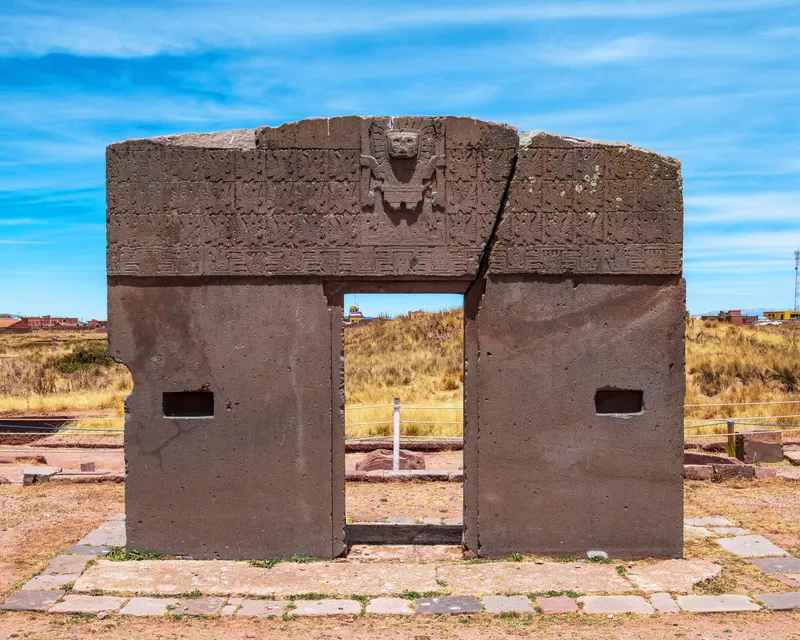
The Gate of the Sun, in the photo at the top of this page, was carved from one andesite block of more than 10 tonnes, about 3 m high and 4 m wide (CIAAAT). Its frieze centers on a figure in the “Staff God” pose, holding a staff in each hand, its head ringed by 24 rays and flanked by 48 smaller figures, 32 with human heads and 16 with bird heads. Some scholars link the central figure to the Inca god Viracocha or the Aymara god Thunupa. CIAAAT reads the bottom band as a solar calendar and UNESCO as an agricultural one; Tiwanaku left no writing to settle it.
European travelers found the gate lying flat and cracked in the mid-19th century, and nobody is sure it stands where it was built. Arthur Posnansky and Edmund Kiss later tied it to “Nordic Aryan” visitors, ideas now classed as pseudoarchaeology.
Puma Punku: the H-blocks, the drill holes and who built it
What Puma Punku was
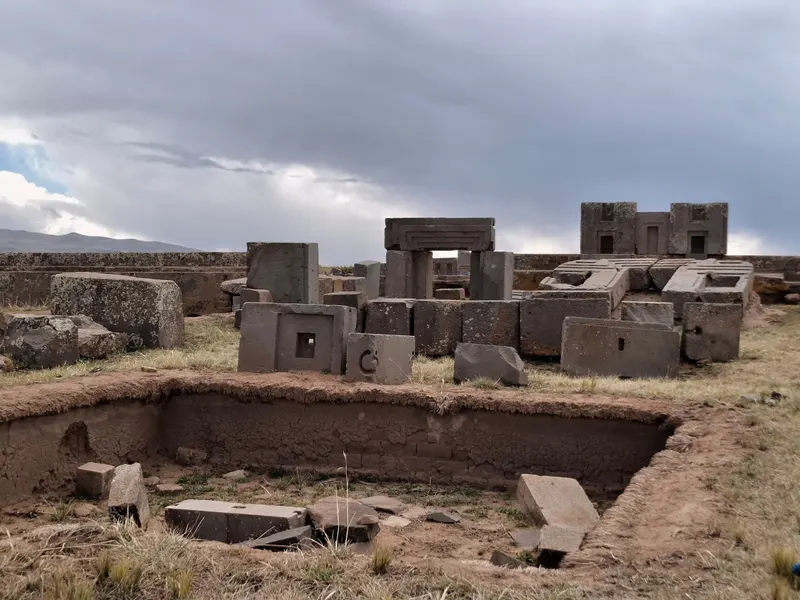
Puma Punku (“Gate of the Puma” in Aymara and Quechua) was a T-shaped platform mound of 167 by 117 m, faced with cut stone, which CIAAAT describes as a three-platform temple facing Lake Titicaca. A radiocarbon date that Alexei Vranich obtained from the oldest layer of fill puts its first construction at AD 536-600. Spanish chroniclers of the 1500s and 1600s described its gateways as wondrous but unfinished, and by the early 1600s only one gateway and one “window” still stood (Vranich, 2018). A 2016 drone survey found the complex covers about 17 ha, only 2 ha of it excavated.
Puma Punku’s stones and where they came from
The biggest blocks are red sandstone slabs. Carlos Ponce Sanginés (1970) measured the largest at about 7.8 by 5.2 by 1.1 m and estimated 131 tonnes from the stone’s density, with the next at about 85 tonnes. Vranich’s 2018 study gives the largest slab as 8.12 by 3.86 by 1.2 m and about 83 tonnes, so treat every figure as an estimate. Petrographic and chemical analyses trace the sandstone to a quarry near Lake Titicaca about 10 km away, and the andesite to the Copacabana Peninsula, 90 km across the lake.
The Puma Punku H-blocks
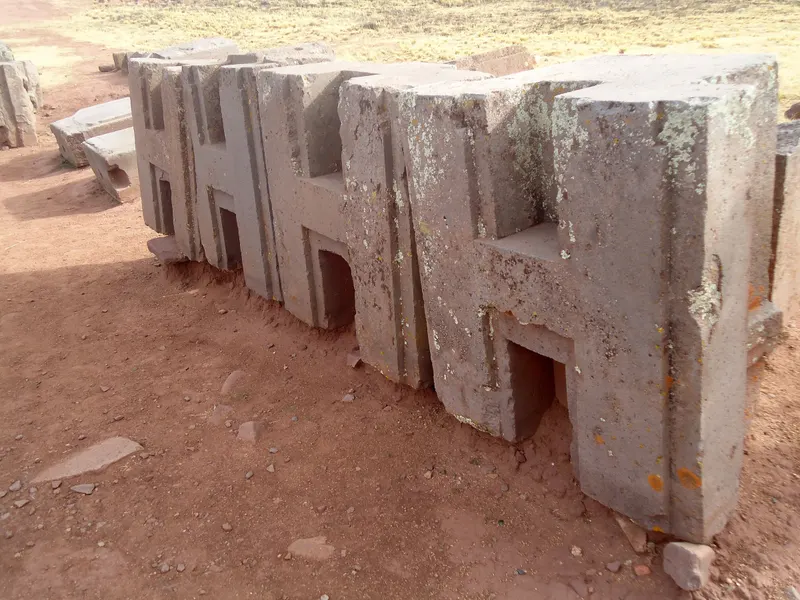
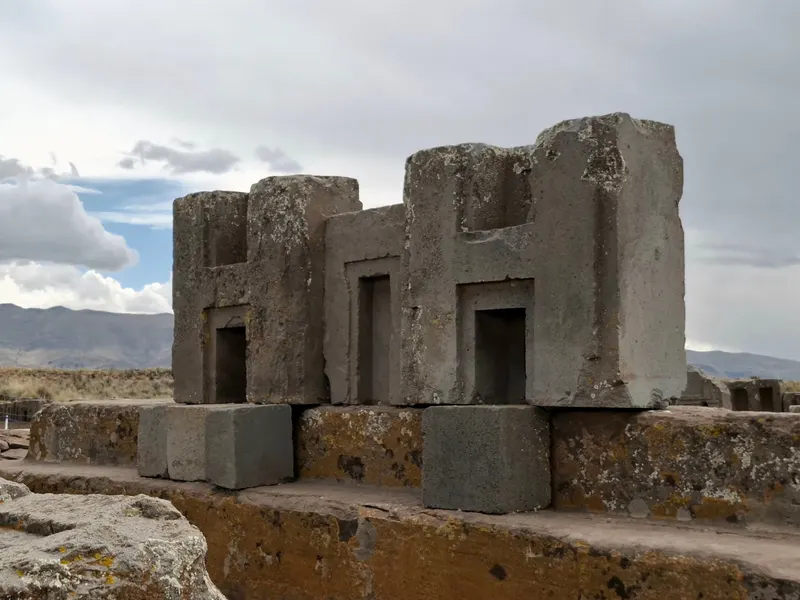
The H-blocks are andesite and far smaller than the slabs. Vranich measured them at about 97 by 99 by 55 cm, roughly 600 kg each, so posts about “90-ton andesite H-blocks” mix up the two stones. They fitted together into rows of blind miniature gateways. The blocks are cut so uniformly that they could be swapped while keeping surfaces level and joints even, though Jean-Pierre Protzen and Stella Nair found their dimensions still differ. A carved stone called the Escritorio del Inca (“Inca’s desk”) is an accurate scale model of the full-size architecture.
Drill holes and metal clamps
The I-shaped slots in some blocks held cramps of copper-arsenic-nickel bronze, cast in place in Puma Punku’s south canal and cold-hammered at the Akapana. Some blocks also carry rows of small, neatly tooled holes; the published work we read describes them without settling what they were for.
How were the stones cut?
Protzen and Nair concluded in 1997 that the builders’ techniques were still unknown and that the sharp interior angles were probably not made with hammerstones. Nair then carved a half-cross motif about 20 cm across with flint, obsidian, hematite and other stone tools, matching Puma Punku’s precision in 40 hours of trial and error (about 25 for an experienced carver, the researchers estimated). The flat inner surface was the hardest part, and bronze tools barely marked the andesite. Nobody has found the builders’ own tools.
Puma Punku myths vs evidence
| Claim | What the evidence says | Source |
|---|---|---|
| Aliens built it | A 3D-printed reconstruction ties its design to older sites in the Titicaca basin, Chiripa and Pukara | Vranich, 2018 |
| It’s 12,000+ years old | Posnansky’s 11,000-17,000-year claim is discredited; radiocarbon gives AD 536-600 | Vranich, 1999 |
| Too precise for hand tools | Stone tools matched the precision of a small motif in 40 hours | Protzen and Nair, 2013 |
| The blocks are poured concrete | Analyses match them to quarries 10 km and 90 km away. Chemist Joseph Davidovits’s 2019 geopolymer papers disagree, but archaeologists treat the blocks as quarried and carved | Ponce Sanginés, 1970; Vranich, 1999 |
| A flood scattered the blocks | Treasure hunters since colonial times and stone mining for buildings and railroad ballast did the damage; none of about 150 andesite blocks remains in place | Isbell, 2004; Vranich, 2018 |
| An Inca site in the jungle | Treeless Altiplano at 3,850 m, built centuries before the Incas arrived (CIAAAT notes a later Inca presence) | UNESCO; CIAAAT |
What happened to Tiwanaku? A short history
| When | What happened |
|---|---|
| About AD 110 | Founding, per a statistical review of reliable radiocarbon dates. Carlos Ponce Sanginés’s 1580 BC still appears in some Bolivian museums |
| AD 500-900 | Tiwanaku at its height (UNESCO) |
| AD 536-600 | First construction at Puma Punku (radiocarbon) |
| AD 1000-1150 | Collapse: about AD 1000 (José Capriles, Penn State) or the first half of the 12th century (UNESCO) |
| 1549 | First written description, by Pedro Cieza de León |
UNESCO credits the city’s wealth to almost 50,000 irrigated raised fields, known locally as sukakollos. Population estimates run from a conservative 10,000-20,000 around AD 800 to Alan Kolata’s 115,000. Geologist Elliott Arnold found evidence of greater aridity around the time of the collapse, and a long drought would have undermined those fields. The Aymara are thought to be Tiwanaku’s descendants, though linguists Paul Heggarty and David Beresford-Jones argue its language was most likely Puquina.
Nobody knows what the builders called their city. The 17th-century Jesuit chronicler Bernabé Cobo recorded an older name, taypiqala, Aymara for “stone in the center”.
In June 2025, a Penn State team led by Capriles described Palaspata, a Tiwanaku temple complex 210 km (130 miles) south, and scholars still debate how much control Tiwanaku had over distant places. Our guide to Bolivia’s top sights covers the rest of the country.
Altitude, weather and what to bring
At about 3,850 m (some sources say 3,885 m), Tiwanaku is 210 m higher than central La Paz (3,640 m) and below El Alto (4,150 m). The CDC rates flying straight into La Paz as high risk for altitude illness, so go on your second or third day or later, and read our altitude sickness guide. The site has almost no shade and is cold outside midday. El Alto’s airport, 200 m higher, averages July lows of -4.1 °C, and November to March is the rainy season (best time to visit Bolivia). Bring small bolivianos, layers, a hat, sunscreen and water. The town has simple restaurants and a health center.
Willkakuti, the Andean New Year (21 June)
Every 21 June, the southern winter solstice, crowds gather in the Kalasasaya at dawn for Willkakuti, the Andean New Year (2026 was year 5534). Normal years draw 10,000-15,000 people, but the blockades cut 2026 to about 800, and CIAAAT waived the fee that day. The next is expected on 21 June 2027. Dress for a freezing dawn, and ask before photographing participants.
Is Tiwanaku worth visiting?
Our take
Yes, if you’re curious about the Andes before the Incas or want to see Puma Punku’s stonework yourself. The Templete’s heads, the Gate of the Sun and the Bennett Monolith are worth the drive alone. If you’re picturing Machu Picchu, lower your expectations. Tiwanaku is platforms and fallen blocks, partly rebuilt in the 20th century. Go with a guide.
Which one is for you?
- If you have one free day: Inti Travel’s all-inclusive shared tour.
- If you speak some Spanish and want to spend under $15: the cable car and a minibus.
- If Puma Punku is the point: a private tour or the minibus, so you set the time at the H-blocks.
- If you want Lake Titicaca too: Solace Trekking’s private day, or two days at Lake Titicaca.
For more, see our day trips from La Paz and La Paz tours compared.
Frequently asked questions
Can you visit Puma Punku?
Yes. Puma Punku is part of the Tiwanaku archaeological site in Bolivia, about 1 km southwest of the main ruins, and the Bs 100 foreigner ticket (about US$8, cash only) covers it along with the Kalasasaya, the Akapana and both museums. The site opens daily from 09:00 to 16:00. The two main shared tours from La Paz give Puma Punku 20-30 minutes, so go private or by minibus if you want longer.
Who lived at Tiwanaku?
Conservative estimates put the city at 10,000-20,000 people around AD 800, while archaeologist Alan Kolata proposed about 115,000. They farmed almost 50,000 raised fields, according to UNESCO. The Aymara people of the region are thought to be their descendants, though linguists Paul Heggarty and David Beresford-Jones argue that Tiwanaku's own language was probably Puquina. Nobody knows what the inhabitants called the city.
What happened to the city of Tiwanaku?
It collapsed between about AD 1000 and 1150, and sources differ on the date. UNESCO places the decline of its political power in the 11th century and the empire's collapse in the first half of the 12th, while Penn State archaeologist José Capriles puts the collapse around AD 1000. Geologist Elliott Arnold found evidence of greater aridity in the region, and a long drought would have hurt the raised-field farming that fed the city. Looters, stone quarriers and treasure hunters then took apart much of what was left.
Who really built Puma Punku?
The people of Tiwanaku, the Andean civilization that peaked around AD 500-900 near the southern shore of Lake Titicaca. Radiocarbon dating puts Puma Punku's first construction at AD 536-600. Its stone came from quarries about 10 km and 90 km away, and Alexei Vranich's 2018 study ties its design to older buildings in the Titicaca basin at Chiripa and Pukara. The Aymara people of the region are thought to be Tiwanaku's descendants.
How were the stones at Puma Punku cut?
Nobody has found the builders' tools, but experiments show stone tools can do most of the job. Stella Nair used tools of flint, obsidian, hematite and other stones to carve a half-cross motif about 20 cm (8 in) across to Puma Punku's precision. It took her 40 hours including trial and error, and the researchers estimated 25 hours for an experienced carver. The flat inner surface of the carving was the hardest part to reproduce, and bronze tools barely worked on the hard andesite.
How far is Puma Punku from Machu Picchu?
About 560 km (350 miles) in a straight line. Machu Picchu is in Peru, northwest of Lake Titicaca, and Puma Punku is in Bolivia, southeast of the lake. Overland, the usual route runs from Cusco to Puno, crosses the border at Desaguadero and passes Tiwanaku, 40-50 km inside Bolivia by road, on the way to La Paz. Our Cusco to La Paz guide covers buses and the border.
What is the lost city under Lake Titicaca?
No sunken city has been confirmed. In 2013, underwater archaeologists working at the Khoa reef in Lake Titicaca found a Tiwanaku-era ceremonial site with offerings: lapis lazuli and ceramic figurines, incense burners and a ceremonial medallion. The finds point to rituals performed on or in the lake, whose southern shore lies about 15 km from the Tiwanaku ruins.
How much does it cost to enter Tiwanaku?
Foreign visitors pay Bs 100 (about US$8 as of September 2026), Bolivian nationals Bs 15 and Bolivian school students Bs 5. The ticket covers the main complex, the Ceramic and Lithic museums and Puma Punku. Payment is cash only, in bolivianos. Buhos Tours' budget shared tour from La Paz (from about $35) excludes the entry fee, so check what your tour includes before you book.
Keep planning