


Quick answer
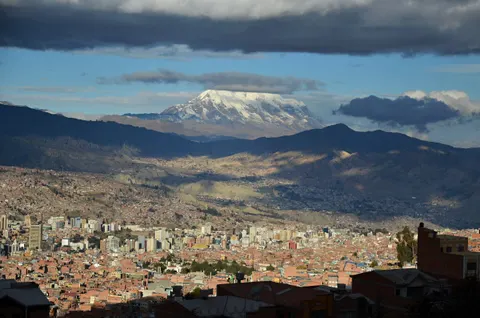
Lake Titicaca sits at about 3,810 m (12,500 ft) on the Bolivia-Peru border. On the Bolivian side you base yourself in Copacabana, 3.5 to 4 hours by road from La Paz, and take a boat to Isla del Sol, which has more than 80 ruins, most from the Inca period. A day tour from La Paz starts around $60 but leaves you under two hours on the island, so we'd stay at least one night.
On this page
- Where is Lake Titicaca?
- Lake Titicaca facts: how high, how big, how deep
- Bolivia or Peru: which side of Lake Titicaca should you visit?
- Things to do on the Bolivian side of Lake Titicaca
- How to get to Lake Titicaca from La Paz
- Day trip or overnight? Lake Titicaca tours from La Paz
- Coming from Peru: Puno to Copacabana via Kasani
- Where to stay: Copacabana or Isla del Sol
- Best time to visit Lake Titicaca
- Altitude, cold water and cash
- History and legends: Inca origins and what’s under the water
- Frequently asked questions
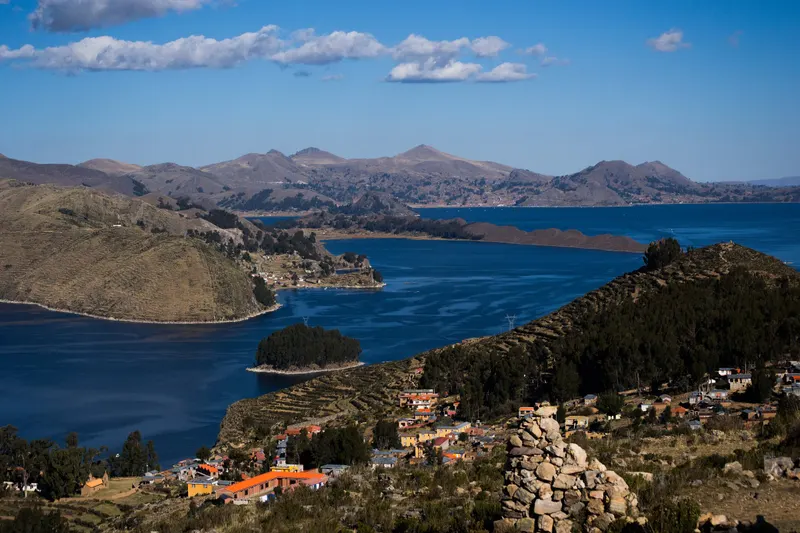
Lake Titicaca straddles the border between Bolivia and Peru at about 3,810 m (12,500 ft). Most English-language guides to it are written from Puno, on the Peruvian shore. This one starts in La Paz, Bolivia, where a visit means a 155 km bus ride of 3.5 to 4 hours, a boat crossing at the Strait of Tiquina and a base in Copacabana, the lakeside town whose Virgin gave Rio de Janeiro’s beach its name.
From Copacabana, boats run to Isla del Sol, where Inca legend placed the birth of the sun, and to the smaller Isla de la Luna. Prices on this page are, at about Bs 12 per US dollar. Bolivia floated the boliviano in June 2026, so any guide still converting at Bs 6.96 is out of date.
- Elevation
- 3,810 m (12,500 ft)
- From La Paz
- 155 km, 3.5-4 h
- Public bus
- Bs 40-60 (about $3.30-5)
- Day tour
- From about $60
- Best months
- May to October
Where is Lake Titicaca?
Lake Titicaca sits on the Andean Altiplano between Peru and Bolivia, at about 3,810 m (12,500 ft). The Bolivian side is in La Paz Department and the Peruvian side in Puno, according to the Ramsar wetland sheets for the Bolivian and Peruvian sectors. Peru holds the western shore and Bolivia the eastern one. Bolivia’s Foreign Ministry puts the lake at 8,562 km², with 56% (4,772 km²) in Peru and 44% (3,790 km²) in Bolivia (September 30, 2019).
In Bolivia, the 1998 Ramsar sheet splits the lake among five provinces of La Paz Department: Camacho, Omasuyos, Los Andes, Ingavi and Manco Kapac. The lake has no outlet to the sea. It is the heart of the TDPS system (Titicaca, the Desaguadero River, Lake Poopó and the Coipasa salt flat), a closed basin of 145,253 km² that Peru and Bolivia manage through the binational Lake Titicaca Authority (ALT, September 2024).
Lake Titicaca facts: how high, how big, how deep
Titicaca is the largest lake in South America by volume and surface area. The Strait of Tiquina splits it into the big northwestern Lago Grande (or Chucuito) and the shallow southeastern Lago Menor (Wiñaymarka), which averages 9 m deep.
| Fact | Figure | Note |
|---|---|---|
| Surface elevation | About 3,810 m (12,500 ft) | ALT gives 3,809 m; varies with the lake level |
| Surface area | About 8,400 km² (3,240 sq mi) | ALT; the Foreign Ministry and the Bolivian Ramsar sheet give 8,562 km² |
| Split by country | Peru 56% (4,772 km²), Bolivia 44% (3,790 km²) | Bolivia’s Foreign Ministry, 2019 |
| Length and width | 170-178 km long, 69-70 km wide (106-111 × 43 mi) | Maximum, by source |
| Depth | 281 m (922 ft) max; averages 135 m in Lago Grande, 9 m in Lago Menor | ALT gives 272 m max |
| Islands | Isla del Sol and Isla de la Luna in Bolivia | Plus the Uros’ floating reed islands in Peru |
| Water in and out | Rivers bring 53% of the water, rain 47%; the Desaguadero is the only outlet | Evaporation takes 91% of the water lost |
| Surface water | Monthly means of 11-14 °C (52-58 °F) in Lago Grande | Cold year-round |
| Protection | Bolivian sector a Ramsar wetland since 1998 | On UNESCO’s Tentative List, not inscribed |
Figures come from the binational Lake Titicaca Authority (ALT, 2024) and the Ramsar sheets for the Bolivian (1998) and Peruvian sectors, except the split by country, from Bolivia’s Foreign Ministry. The level moves with the rains, and it fell 74 cm between April and November 2023, in what the weather service SENAMHI called one of the worst droughts in 30 years.
Titicaca is often called the highest navigable lake in the world, a claim usually taken to mean commercial boats, since smaller lakes lie higher.
From Copacabana, both islands lie to the north, Tiquina to the southeast and the Kasani border with Peru about 8 km south.
What does Titicaca mean?
Nobody agrees. In 1948 the anthropologist Weston La Barre recorded the Aymara name titiq’aq’a, “gray, lead-colored puma,” and “rock of the puma” is another common translation. The archaeologist Charles Stanish traces it to thakhsi cala, the 15th- and 16th-century name of the sacred rock on Isla del Sol. Say tee-tee-KAH-kah.
Wildlife: the giant frog, the flightless grebe and the fish
The Titicaca water frog (Telmatobius culeus) lives only in the lake’s basin and spends its whole life underwater. Its lungs are about a third the size of a comparable frog’s, so it breathes mostly through baggy folds of skin, hence the nickname “scrotum frog.” The IUCN rated it Endangered in 2020 (older assessments said Critically Endangered), and BirdLife gives the same status to the flightless Titicaca grebe, found nowhere else.
The native fish are small Orestias killifish, 23 species found only in the lake, sold locally as karachi and ispi. One, the Titicaca orestias, hasn’t been seen since 1938. Trout were introduced in the 1940s, and pejerrey (Argentine silverside) swam up the Desaguadero from Lake Poopó by 1955.
Bolivia or Peru: which side of Lake Titicaca should you visit?
If the picture in your head is a floating island made of reeds, you’re thinking of Peru. The Uros islands sit about 5 km off the port of Puno, and Taquile, whose textile art UNESCO recognized in 2005, lies 45 km offshore. Bolivian communities have built a few reed islands for tourism since 2007, the first at Sahuiña, about 5 km from Copacabana, but we found no 2026 visitor information for them and no La Paz tour that stops there.
| Bolivian side | Peruvian side | |
|---|---|---|
| Base town | Copacabana (3,841 m) | Puno |
| Best-known trips | Isla del Sol, Isla de la Luna, Copacabana’s basilica | Uros floating islands, Taquile |
| Getting there | 155 km from La Paz | Puno is 390 km by road from Cusco |
| Island communities | Aymara, on Isla del Sol | Quechua-speaking, on Taquile |
Which one is for you?
- If you’re coming from Cusco or Puno: see the Uros from Puno, then cross at Kasani and give the Bolivian side two nights.
- If you’re in La Paz with one free day: the Copacabana and Isla del Sol day tour.
- If you have two or three days: a night in Yumani on Isla del Sol, plus a boat to Isla de la Luna.
Things to do on the Bolivian side of Lake Titicaca
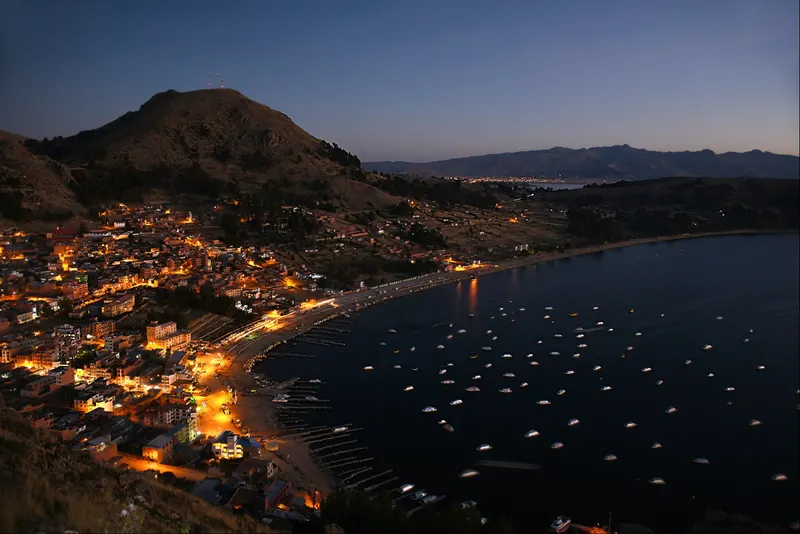
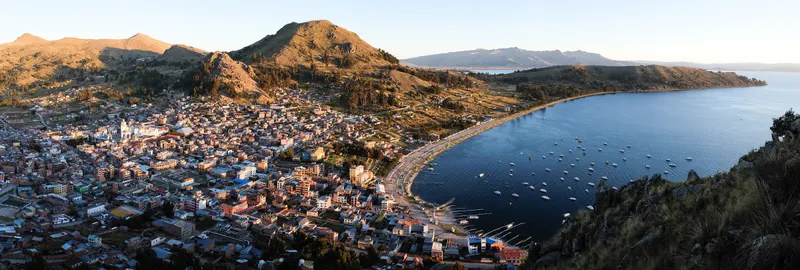
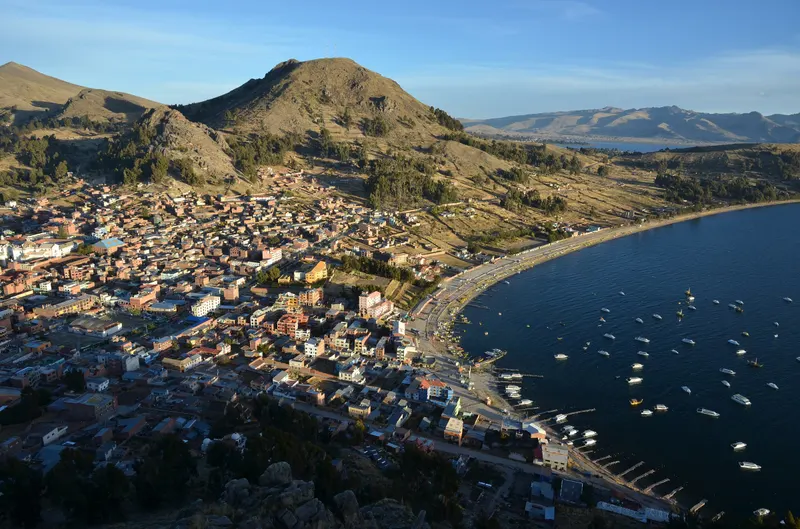
Copacabana, the base town
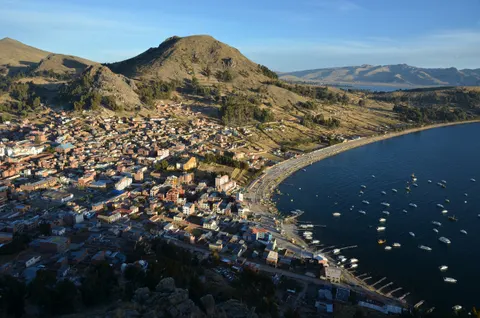
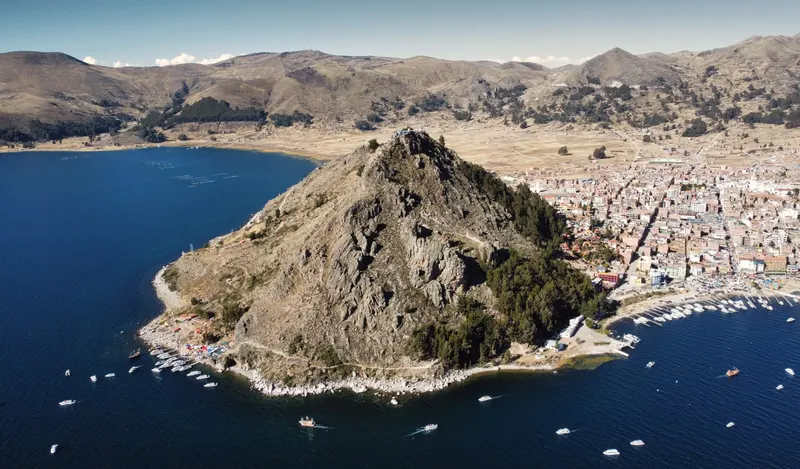
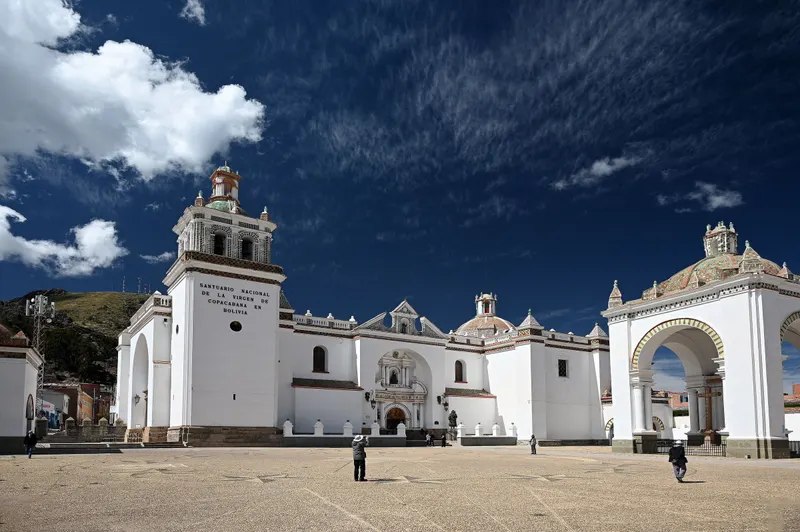
Copacabana (3,841 m) is where the buses stop and the boats leave. Its white basilica went up between 1601 and 1619 to house the Virgin of Copacabana, carved at the end of the 16th century by Francisco Tito Yupanqui, a descendant of the Incas (1583 by tradition; some sources say 1582). Vehicle blessings take place at the basilica entrance.
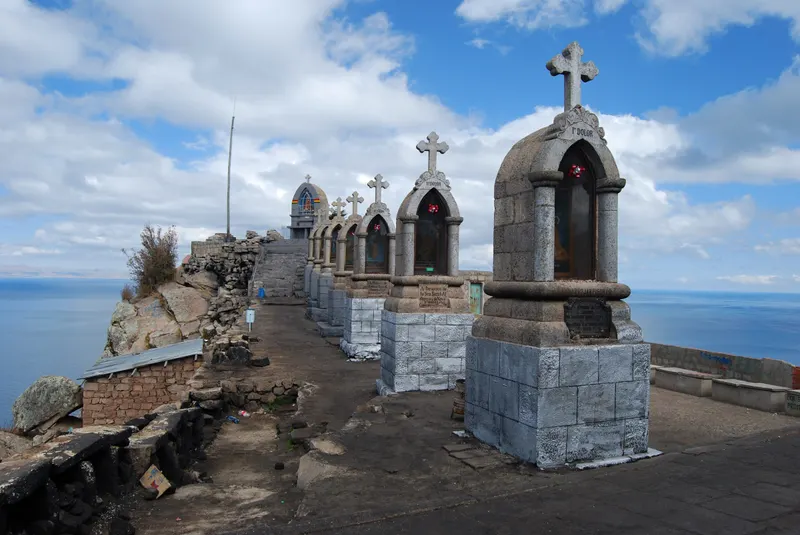
Cerro Calvario rises about 120 m above town, with 14 Stations of the Cross, built in 1946, along the 45-minute climb. Go in the late afternoon for sunset over the bay. More in our Copacabana, Bolivia guide.
Isla del Sol
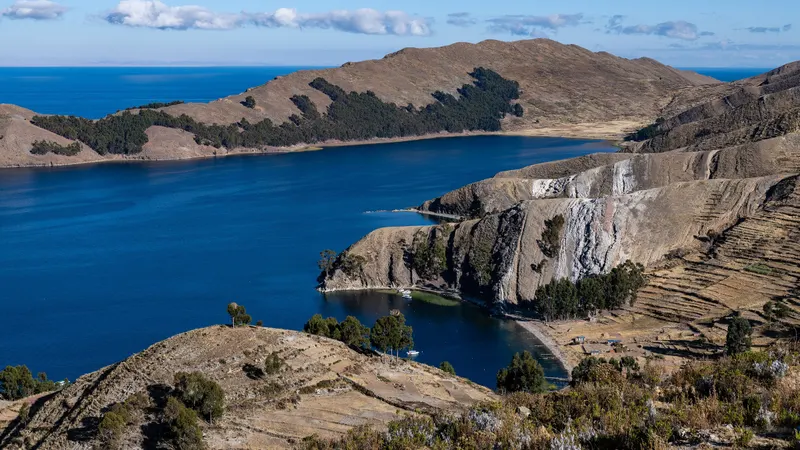
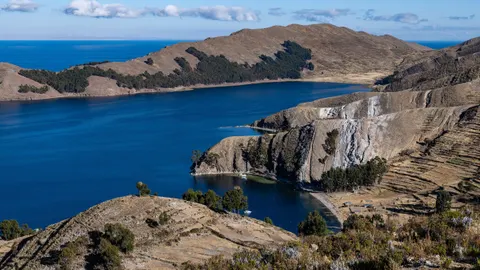
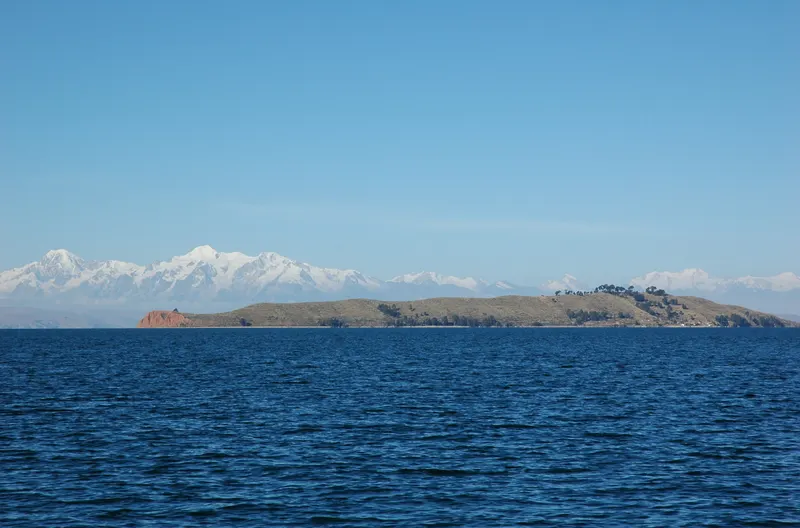
Isla del Sol holds more than 80 ruins, most from the Inca period, and three communities. Yumani, the southern village, has the Inca Stairway rising from the dock and the Pilko Kaina temple on the coast. Challapampa, in the north, is closest to the Chincana ruins, the Sacred Rock of the Inca origin story and a small museum of objects recovered from the lake. Challa lies between the two. Paths top out around 4,050 m (13,300 ft).
Boats leave Copacabana around 8:30 a.m. and 1:30 p.m. and take about 1 h 30 min to Yumani. Fares quoted in 2026 run from Bs 30-40 return to Bs 30-50 (about $2.50-4) each way. Each community charges Bs 10-20 in cash (sources disagree), and the island has no ATMs. Access to the north has been intermittent since a 2017 dispute between Challa and Challapampa (Hosteltur), so ask at the Copacabana dock the day before. Our Isla del Sol guide covers boats, trails and lodging.


Isla de la Luna
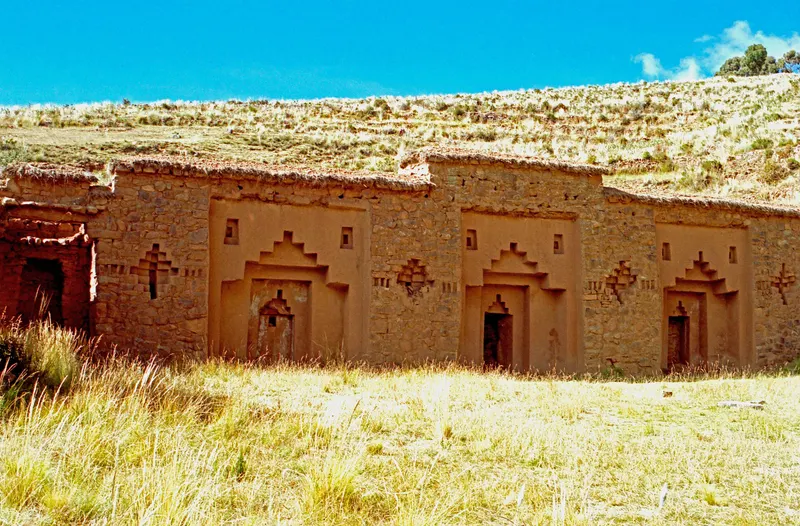
Isla de la Luna, or Koati, is a smaller island east of Isla del Sol. Its main site, Iñak Uyu, is a complex of stepped niches often called the Temple of the Virgins and linked to the aqllas, women chosen to serve the Inca state. Boats take about 1 h 30 min from Copacabana, and operators sell combined Sol and Luna trips for about Bs 50-70 return (September 2026). Day tours from La Paz skip it, so you need a night at the lake.
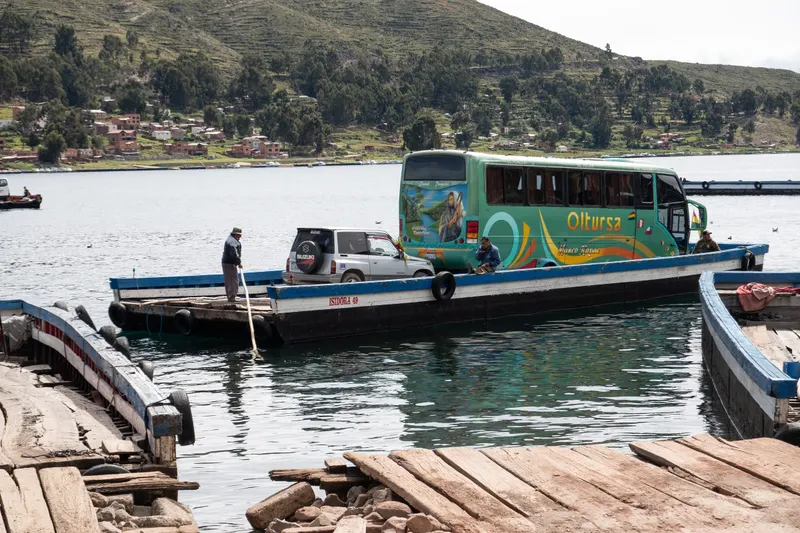
Strait of Tiquina
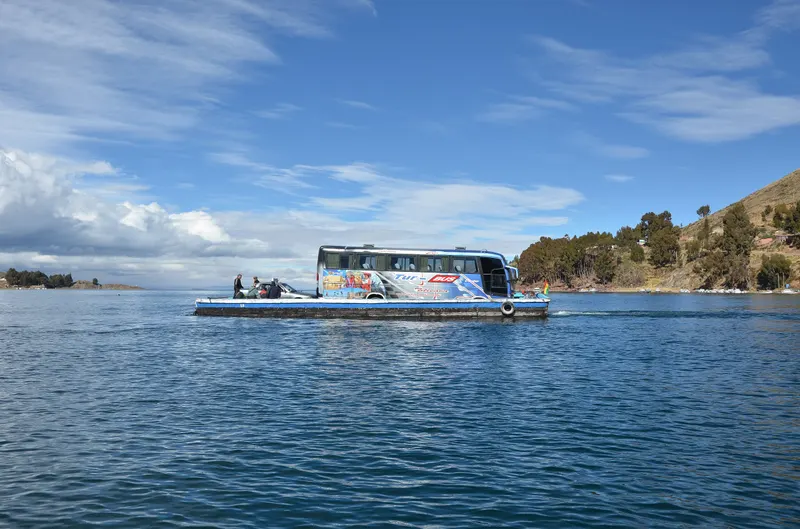
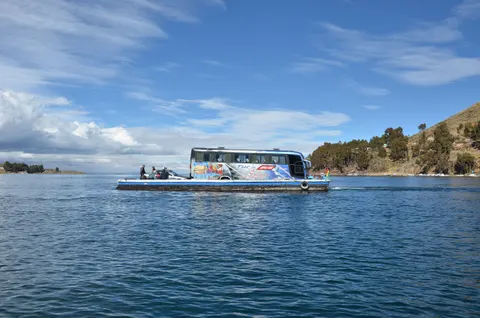
Every bus from La Paz to Copacabana crosses this strait between San Pablo and San Pedro de Tiquina, less than 1 km wide (780-850 m, by source). Passengers ride a small launch while the bus goes over on a wooden barge. Allow 20-45 minutes, and keep your passport, cash and phone with you. San Pedro hosts a Bolivian Navy flotilla headquarters, in a country with no coastline. A bridge design was finished in 2024 and sent back for redesign that November (La Razón, archived), and buses still cross by barge.
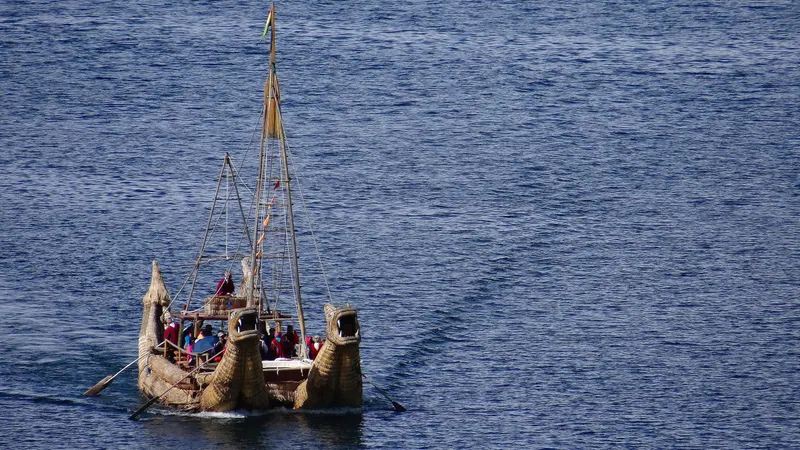
Huatajata and the reed-boat builders
Huatajata, 82 km from La Paz on the Copacabana road, sits on Lago Menor and is known for boats built from totora reed. Three builders from Lake Titicaca, Demetrio, Juan and José Limachi, made Thor Heyerdahl’s Ra II from Ethiopian papyrus, and in 1970 it sailed from Morocco to Barbados. Private drivers and tours can stop there.
How to get to Lake Titicaca from La Paz
Allow 3.5 to 4 hours for the 155 km to Copacabana, including Tiquina, and 30-60 minutes more on weekends and holidays.
| Option | Leaves from | When | Cost (September 2026) | Good to know |
|---|---|---|---|---|
| Public bus or minibus | Cementerio General area, or the bus terminal on Av. Perú | About 7:00-10:00 a.m. from the terminal; no night buses | Bs 40-60 (about $3.30-5), plus Bs 2-5 for the Tiquina launch | Returns run about 8:00 a.m. to 7:00 p.m. |
| Tourist bus (e.g., Bolivia Hop) | Hotel pickup | Morning | Bs 80-100 (about $7-8) | Or a Viator bus ticket from about $14, one review so far |
| Guided day tour | Hotel pickup from 6:45 a.m. | Back about 10:00-10:30 p.m. | From about $60 | Includes the boat to Isla del Sol |
Fares have moved all year. After the December 2025 fuel-subsidy cut, Unitel found buses at Bs 40-60 and the Tiquina launch at Bs 5 (some 2026 guides still say Bs 2). When the road reopened after the blockades, companies charged Bs 40 (ABI, June 2026). Bus companies and timetables are in our Copacabana guide.
Before you go (September 2026)
Blockades cut the roads out of La Paz and El Alto for about seven weeks in May and June 2026, until a police and military operation reopened the Copacabana road on June 23. A state of exception runs to about mid-December 2026 and could bring curfews. Diesel rose from Bs 9.80 to Bs 17.95 a liter on September 18, so fares may climb, and fuel shortages can cancel departures. The UK Foreign Office reports express kidnappings around the Cementerio General and at overland borders, says to order radio taxis by phone and advises a direct bus from Copacabana to La Paz. See our Bolivia safety update.
Day trip or overnight? Lake Titicaca tours from La Paz
Viator’s most-reviewed Titicaca day tour, run by Bolivia Hop, publishes this schedule (listing updated September 29, 2026):
| Time | What happens |
|---|---|
| 7:00 a.m. | Bus leaves La Paz (pickups from 6:45) |
| 9:45 a.m. | Tiquina viewpoint and crossing |
| 11:30 a.m. | Copacabana, free time for lunch |
| 12:30 p.m. | Boat to Isla del Sol, landing at Yumani at 1:40 |
| 1:40-3:20 p.m. | Walk to Pilko Kaina and along the south coast |
| 3:20 p.m. | Boat back to Copacabana; bus leaves at 5:45 |
| 10:00-10:30 p.m. | Back in La Paz |
That’s 1 h 40 min on the south end of Isla del Sol in a 15.5-hour day, about nine of them on the road.
| Day tour | 2-day tour, night on the island | On your own, 2 days | |
|---|---|---|---|
| Price | From about $60 | From about $70, plus a bed | About Bs 125-250 ($10-21) for buses, launches, boat and fees, plus a bed |
| Time on Isla del Sol | 1 h 40 min, south only | About 25 hours, back on the 3:30 p.m. boat | As long as you like |
| Not included | Food, Bs 20 island fee | Bed (the guide can book one), food, Bs 10 Yumani fee | Nothing arranged |
| Best for | One free day | A night on the island with no planning | Isla de la Luna, the north, early boats |
Stay at least one night
The day tour suits a single free day in La Paz. A night in Yumani adds the sunset, the sunrise and time to walk the island. A night in Copacabana adds the Cerro Calvario sunset and the 8:30 a.m. boat, early enough for the walk from the north end back to Yumani (about three hours, by Bolivia Hop’s estimate) when the north is open.
Lake Titicaca tours from La Paz
Book on Viator From $59Full Day Guided Tour in Copacabana and Isla del SolFree cancellationCheck availability
 From $692 Day Trip From La Paz: Copacabana & Isla del Sol (Night in Isla del Sol)Free cancellationCheck availability
 From $200Private Tiwanaku and Titicaca Day Trip from La PazFree cancellationCheck availability
Prices in US$ per person from Viator as of Sep 30, 2026. They change; you see the final price before paying.
Viator lists 36 Lake Titicaca products, but in September 2026 only two tours from La Paz had more than 100 reviews, and Bolivia Hop runs both. The private Tiwanaku tour (from about $200, lunch included) adds lakeshore communities and skips Copacabana. More in our La Paz tours and day trips from La Paz guides.
What to skip
- The Tiwanaku and Titicaca combo if Isla del Sol is what you’re after. Give Tiwanaku its own day.
- A lake trip the day before an international flight. Blockades closed this road for weeks in 2026.
- The day tour from December to March if the mountain views are the point. Each of those months brings over 100 mm of rain to Copacabana, and nine hours on a bus to look at cloud is a poor trade.
Coming from Peru: Puno to Copacabana via Kasani
The Kasani border post is about 8 km from Copacabana, and the bus from Puno takes 3-4 hours door to door. Bolivian Life (June 2026) gives published hours of roughly 7:30 a.m. to 6:00 p.m. on the Peruvian side and 45-90 minutes for formalities, so cross around midday. Bolivia (UTC-4) is one hour ahead of Peru. US citizens have entered Bolivia visa-free since December 1, 2025; other passports should check our Bolivia visa guide.
A Puno agency sells a 12-hour Copacabana and Isla del Sol tour from Puno from about $130, with bus, guide, lunch, island entry and a shared boat, and it can drop you in La Paz. Our Cusco to La Paz guide covers the buses and the border.
Where to stay: Copacabana or Isla del Sol
Copacabana has the boats, buses, restaurants, ATMs (which can run dry) and the widest choice of beds. Yumani, on the south of Isla del Sol at nearly 4,000 m, is quieter and gets you sunset and sunrise on the island, but you’ll climb stairs from the dock with your bag and pay mostly in cash. Nights are cold in both. Copacabana’s average lows run 2-5 °C (36-42 °F) and fall below freezing on some dry-season nights. Hotel Gloria and La Cúpula list room heating on their official sites; elsewhere, ask about heaters or extra blankets.
Hotel Rosario Lago Titicaca
Best for: Four-star comfort right on the lake
Grupo Rosario's Copacabana hotel sits on the lakeshore on Av. Costanera and is the only four-star on this list, with a garden, terrace and restaurant. Pick it if you want comfort after the bus from La Paz. Copacabana is at 3,841 m, so nights are cold year-round.
- 4 stars (official site)
- On the Lake Titicaca shore
- Garden, terrace and restaurant
Hotel La Cúpula
Best for: Lake-view gardens and a vegetarian-friendly kitchen
Set at the foot of Cerro Calvario, with gardens, hammocks and loungers facing the lake. It has 19 rooms in five categories, including a jacuzzi suite, and a restaurant with vegetarian and vegan dishes as well as trout. Its official rooms page lists central heating or a fireplace and breakfast included, which matters at 3,841 m.
- 19 rooms, jacuzzi suite
- Heating or fireplace (official site)
- Hammock garden facing the lake
- Vegetarian and vegan menu
Hostal Las Olas
Best for: Characterful suites with lake views
Fourteen individually designed suites on the slope of Cerro Calvario, at the end of Calle Michel Pérez, with lake views from the cabins. There's a hammock garden, and it sits about 600 m from the Basilica, a little out of the center. With only 14 suites, book ahead for the dry season (May to October).
- 14 individually designed suites
- Lake views from the cabins
- Hammock garden
Hotel Gloria Copacabana
Best for: Heating and breakfast on a budget
A hotel in central Copacabana with lake views, run by the same group as La Paz's Hotel Gloria. Its official site lists heating, insulated windows and down duvets in the rooms, and every rate includes breakfast. It's geared to families, with mini golf, a racquetball court, a small football pitch and a games room.
- Heating and insulated windows
- Breakfast included
- Single or double Bs 295-440 on its website (Sept 2026)
Hotel Utama
Best for: Low price with a private bathroom
One of the most-reviewed budget hotels in town, with private bathrooms and hot water, Wi-Fi and its own restaurant. Fine for a night before or after Isla del Sol. Ask about heating or extra blankets when you book.
- Private bathroom with hot water
- Restaurant and garden
- Free Wi-Fi
Hostal Sonia
Best for: Tight budgets, steps from the Basilica
A simple guesthouse about 100 m from the Basilica and 200 m from the main square, so all of central Copacabana is walkable. It's one of the most-reviewed cheap stays in the center. It's a basic place, so pack warm layers for the night.
- ~100 m from the Basilica
- ~200 m from the main square
- From about Bs 290 a night for two (Sept 2026)
Olas del Titicaca Backpackers Hostel
Best for: Backpackers who want a shared kitchen
A backpacker hostel with a shared kitchen and lounge, a terrace and Wi-Fi, and the cheapest option on this list. Useful if you arrive by bus from Peru or La Paz and move on the next day. Expect basic facilities and cold nights.
- Shared kitchen
- Shared lounge and terrace
- Free Wi-Fi
Ecolodge El Descanso
Best for: Sleeping on the island on a budget
A lodge in the Yumani community on the south of Isla del Sol, with a bar and a restaurant serving pizza, local and international food. Staying here gets you the sunset and sunrise over the lake that day-trippers miss. You reach it by climbing stairs from the dock, and there are no ATMs on the island, so bring cash.
- In Yumani, Isla del Sol
- Restaurant and bar
- No ATMs on the island, so pay cash
Price band for a double room in the dry season. Confirm rates and dates on Expedia.
For more options, compare Copacabana hotels on Expedia or browse Isla del Sol stays on Expedia.
Best time to visit Lake Titicaca
May to October
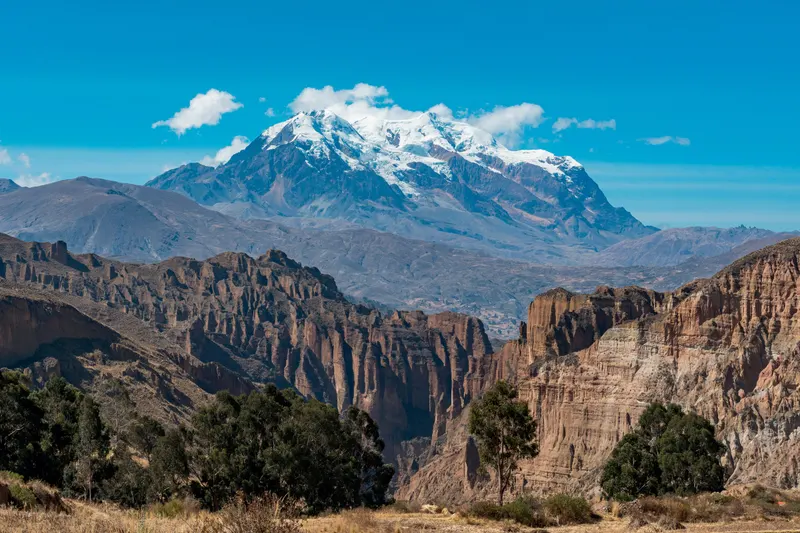
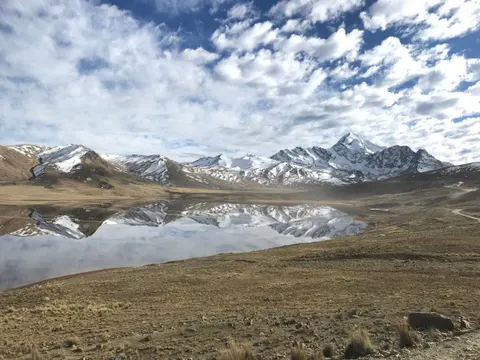
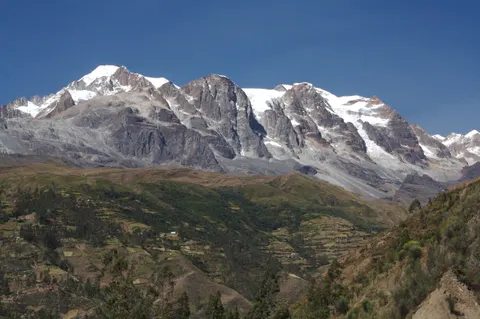
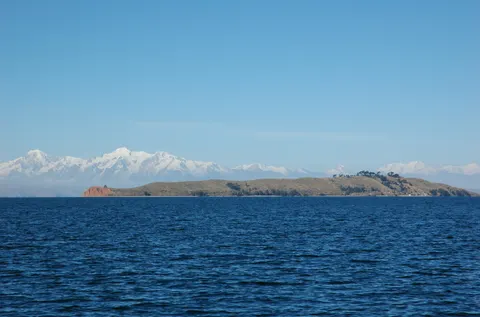
Dry seasonClear skies, the snowy Cordillera Real sharp across the water and cold nights. Copacabana’s average high bottoms out at 13.3 °C (56 °F) in July.
Verdict: The best months for views and boat trips.
November to March
Rainy seasonJanuary is the wettest month, with about 185 mm of rain in Copacabana, and Canada’s travel advice warns that floods and landslides can block Bolivian roads in these months.
Verdict: Still worth the trip. Keep a spare day.
Pilgrims fill Copacabana for Candelaria (February 2), for the patron feast of August 5-6, which runs into Independence Day, and for Holy Week, so book beds ahead on those dates. For the rest of the country, see the best time to visit Bolivia.
Altitude, cold water and cash
Copacabana (3,841 m, 12,602 ft) is about 200 m above central La Paz, and Yumani’s lodges sit near 4,000 m (Ecolodge La Estancia gives 4,010 m). The CDC advises raising your sleeping altitude by no more than 500 m a night above 3,000 m, so both are within reach after two or three nights in La Paz. Don’t come straight from sea level, since the island’s trails reach about 4,050 m. More in our La Paz altitude sickness guide.
Bring bolivianos from La Paz in small notes, since boats and community fees are cash only. At about Bs 12 per dollar (September 2026), Bs 100 is roughly $8. See our Bolivia currency guide.
How clean is Lake Titicaca?
Open water is fine for a cold dip. Keep away from the town bays. Cohana Bay, on Bolivia’s Lago Menor, takes the wastewater of El Alto and Viacha, and Puno’s bay takes untreated sewage. A 2011 UN report found “alarming concentrations” of cadmium, arsenic and lead in parts of the lake, and in October 2016 about 10,000 Titicaca water frogs were found dead in the Coata River, which feeds the lake from Peru.
History and legends: Inca origins and what’s under the water
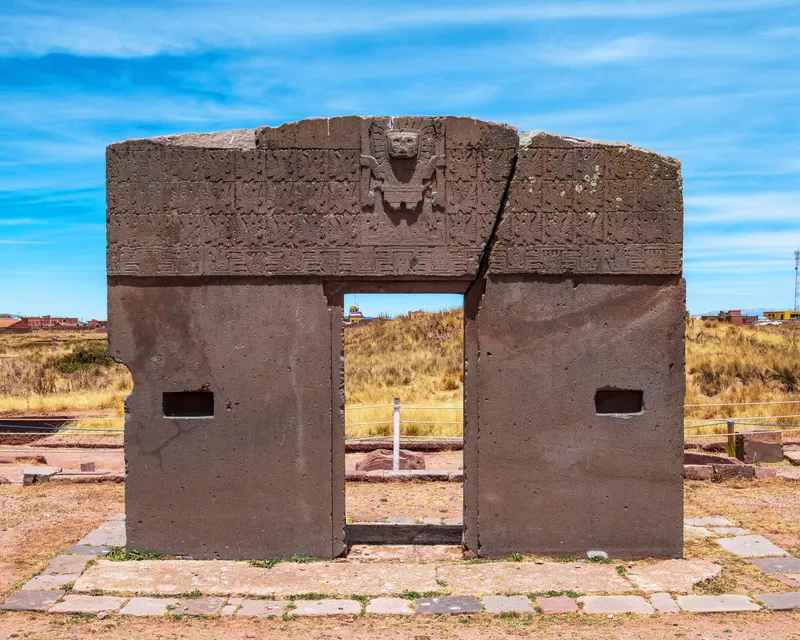
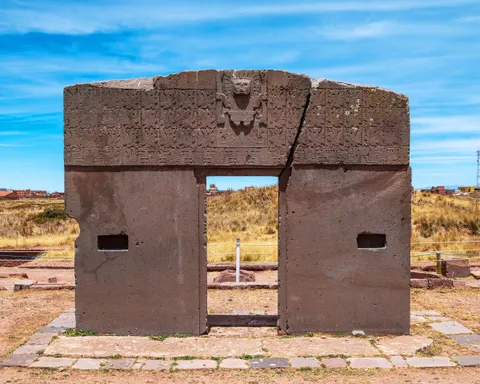
In Inca belief the sun was born on Isla del Sol, and Manco Cápac and Mama Ocllo, the legendary founders of the Inca dynasty, rose from the lake to found Cusco. Tiwanaku, whose culture flourished from about 300 to 1150 AD, lies about 15 km from the shore; see our Tiwanaku and Puma Punku guide.
From the late 1980s to 1992, Johan Reinhard directed dives off Isla del Sol that recovered Inca and Tiwanaku offerings, now in the Challapampa museum. From 2012 to 2018 Bolivian and Belgian divers made more than 1,350 dives and recorded about 20 submerged sites and over 20,000 objects, including feline-shaped incense burners and carved llamas from the Khoa reef (UNESCO). UNESCO describes a planned floating, partly submerged museum for the finds; we found no sign it has been built.
To fit the lake into a longer route, see our Bolivia itinerary and the other things to do in Bolivia.
Frequently asked questions
Can you do a day trip from La Paz to Lake Titicaca?
Yes. Day tours pick you up around 6:45 a.m., reach Copacabana at 11:30, land on Isla del Sol at 1:40 p.m. and leave it at 3:20, and get back to La Paz about 10:00-10:30 p.m. That's 1 h 40 min on the island in a 15.5-hour day, from about $60. A night in Copacabana or on the island shows you far more. Compare options in our La Paz tours guide.
Is it better to visit Lake Titicaca in Peru or Bolivia?
Go to Bolivia for Isla del Sol, the Inca ruins of Isla de la Luna and Copacabana's basilica, all 3.5-4 hours from La Paz. Go to Peru for the Uros floating reed islands and Taquile, both reached from Puno. If you're traveling between Cusco and La Paz anyway, do both. See Puno first, then cross the border at Kasani and spend a night or two on the Bolivian side.
Is Lake Titicaca worth visiting?
Yes, if you give it a night. The Bolivian side has Inca sites on Isla del Sol and Isla de la Luna, a pilgrimage town with a basilica finished in 1619, and views across the water to the glaciers of the Cordillera Real. As a day trip from La Paz it's mostly road, with about nine hours on a bus for under two hours on the island.
How much does a trip to Lake Titicaca from La Paz cost?
There's no ticket for the lake itself. On your own, budget Bs 80-120 for the return bus, Bs 4-10 for the two Tiquina launches, Bs 30-100 for a return boat to Isla del Sol and Bs 10-20 per community on the island. That comes to about Bs 125-250 ($10-21) before food and lodging. Guided day tours start around $60.
Can you swim in Lake Titicaca, and is it clean?
You can, but the surface water stays at 10-14 °C (50-57 °F) all year, so keep it to a quick dip in open water away from docks and town bays. Those bays are the dirty part. Bolivia's Cohana Bay receives wastewater from El Alto and Viacha, Puno's bay takes untreated sewage, and a 2011 UN report found alarming levels of cadmium, arsenic and lead in parts of the lake.
Is Lake Titicaca near Machu Picchu?
Not very. Machu Picchu is reached from Cusco, and Puno, the main Peruvian lake town, is 390 km from Cusco by road; PeruRail's Titicaca train takes about 10.5 hours. Copacabana, on the Bolivian shore, is roughly another 140 km past Puno. You can link them overland from Cusco to Puno, Copacabana and La Paz, and our Cusco to La Paz guide covers the buses and the border.
What was found in Lake Titicaca?
From 2012 to 2018 a Bolivian and Belgian team made more than 1,350 dives and recorded about 20 submerged sites and over 20,000 objects, from Tiwanaku times (300-1150 AD) to the Inca period (1400-1532), according to UNESCO. Finds include offerings from the Khoa reef such as feline-shaped incense burners and carved llamas. Earlier dives off Isla del Sol, directed by Johan Reinhard until 1992, recovered Inca and Tiwanaku offerings now shown in the museum at Challapampa.
How do you pronounce Titicaca, and what does it mean?
Say tee-tee-KAH-kah. Nobody agrees on where the name comes from. In 1948 the anthropologist Weston La Barre recorded the Aymara name titiq'aq'a, a gray or lead-colored puma, and another common translation is rock of the puma. The archaeologist Charles Stanish traces it to thakhsi cala, the 15th- and 16th-century name of the sacred rock at the north end of Isla del Sol.
Which Bolivian department is Lake Titicaca in?
La Paz Department. The Ramsar wetland sheet for the Bolivian sector (1998) places the whole Bolivian side of the lake in La Paz Department, across five provinces: Camacho, Omasuyos, Los Andes, Ingavi and Manco Kapac. On the Peruvian side the lake is in Puno.
What basin does Lake Titicaca belong to?
A closed basin with no outlet to the sea. Titicaca is the heart of the TDPS system (Lake Titicaca, the Desaguadero River, Lake Poopó and the Coipasa salt flat), which Peru and Bolivia manage through the binational Lake Titicaca Authority (ALT). The ALT puts the system at 145,253 km², and the Bolivian Ramsar sheet puts the lake's own catchment at 57,340 km².
Keep planning